Showing posts with label Diagnosis. Show all posts

Friday, June 28, 2013

Eight Years of Adventures

Next week will be the eight year anniversary of Adventures in Raising a Disabled Child.  A year and a half after my daughter's birth and about a year after her diagnosis I decided to write about our family's experiences.  You can find my first, short, introductory post here.  When I set things up I decided to label the experiences I share "adventures" to give emphasis on the positive things we'd be experiencing.  I think it's important to focus on the happy moments, although I've not held back from sharing some of the challenges as well.

And now Whitney's coming up on her 10th birthday!  It's hard to believe.  As time has gone by, I've posted less than I did in the early years.  I think some of the reason for that, is that raising Whitney has just become life for Melanie and I.  It's gotten much harder to distinguish the distinctive "raising a disabled child" experiences from everyday parenting.  It's just what we do now.  Without even a second thought.  But I still find so much inspiration that it's hard not to share.

As I look back on those first posts, I can see how at how earth-shattering Whitney's 1p36 Deletion diagnosis was for our family even a year after it happened.  It makes me glad that I've been writing all these years.  Because the central theme of my family's adventures is that there's hope.  When a child is diagnosed with a disability, or special needs, as we say now, it dumps life upside down.  But life doesn't end when a diagnosis comes.  In fact, it's probably just getting started.  Need proof that it's going to be okay?  Here's a record of eight years of tears, joys and laughter for you to enjoy. And we're just getting started here too...


Thursday, October 13, 2011

1p36 Deletion Syndrome Resources

Most of the time I love sharing experiences and information that families with special needs can all relate to regardless of specific circumstances.  But I want to take just a second to share some information that I've found useful with regard to my daughter's genetic disorder. Whitney was diagnosed with 1p36 Deletion Syndrome in the summer of 2004.  It's hard to believe that seven years have passed.  Since then, we've met many amazing families who have been affected by the same genetic deletion.  They've pointed us in the direction of internet support groups and charitable organizations to help answer our questions and be there for us when we've needed it.  If you've just joined us on our adventures in raising Whitney, and you have a loved one affected by 1p36 Deletion Syndrome, please take advantage of the following wonderful resources:

1p36 Deletion Support & Awareness - This non-profit organization was founded in 2008 by concerned parents and caregivers affected by 1p36 Deletion Syndrome.  Their mission is "to help individuals affected by chromosome 1p36 abnormalities overcome the obstacles they face to be able to lead healthy, happy and productive lives."  The organization sponsors annual conferences for families and caregivers working to fulfill that mission.  You can read their quarterly newsletters, learn about upcoming awareness efforts and make a contribution by visiting www.1p36dsa.org.

1p36 Deletion Awareness & Support Facebook Group - To get in touch with parents and others who have been touched by someone with a 1p36 Deletion please request membership to this Facebook group.  There are now over 245 members with experiences and knowledge to share.  The environment is friendly and supportive.  And it's a great place to get your questions answers if a loved one of yours has just been diagnosed.

Signature Genomics - This company was founded by Lisa Shaffer a genetics researcher who is a pioneer in microarray-based cytogenetic diagnostics.  In other words, the genetic testing techniques she developed have allowed for greater understanding of 1p36 Deletion Syndrome and other genetic conditions.  She is an expert on 1p36 Deletions and has an ongoing study that many 1p36 patients have participated in.  To get more information about this company, Dr. Shaffer's study and how they might be able to help as you learn more about a loved one's condition, visit www.signaturegenomics.com.

I hope these resources will help visitors out.  My family has benefited so much by being in contact with other great people around the world who are experiencing the same things we are.  And if you have questions or other resources you've used, feel free to post in the comments.

Friday, June 10, 2011

The New Norm

When your child is diagnosed with some kind of disability the whole world seems like it's coming to an end. Future plans are dashed to pieces and your mind is left considering the frightening "now what" reality of life.

As time progresses, life begins to revolve around doctors appointments, therapists visits, medical equipment, special ed classes and it crowds almost everything else out. You feel a sense of panic as you try to stay afloat amid the needs of your child and the work that comes with them. You seek out support from others going through similar things for the strength to carry on.

That's how things felt for Melanie and I when Whitney was diagnosed with 1p36 Deletion Syndrome almost exactly seven years ago. But this last week I came to a very interesting realization. I've become used to and even comfortable with the life our little family has come to live.

Juggling Whitney's care is still time consuming and sometimes exhausting for Melanie and I. But we've become accustomed to it and it doesn't take the same toll on us any more. In fact, we've settled into a new norm that feels healthy. We've figured out how to stand on our own feet and the tears stopped long ago. In fact, life is pretty good most of the time.

I don't think Melanie and I can really take credit for the progress we've made. We're ordinary folks just like anyone else, but we've put one foot in front of the other and kept moving forward for so long that now it's habit. And, along the way, we've made time for evening soccer games, walks through the neighborhood, movie nights, birthday parties, family vacations and all kinds of "normal" things that fit into our lives just fine.

I mention this not to say, "We've arrived!" But instead, to make sure those of you who are out there reading know that it gets better. You may be in the thick of a very painful and difficult adjustment because of your own child's diagnosis. But if you can just keep moving forward, taking it one day at a time, someday, you'll wake up and realize that you and your special needs child are doing just fine. In fact, before you know it, you'll settle into a new norm and you'll be enjoying life. Don't give up hope. Mark my words. You'll get there!

Wednesday, May 16, 2007

Choosing Your Children?

I'm an avid reader of of the Freakonomics blog run by the best-selling writers of the book Freakonomics. This past week, they covered a topic I find startling. The New York Times reports that as more prenatal tests for Down Syndrome are administered an alarming trend has surfaced. As many as ninety percent of mothers whose unborn children have Down Syndrome choose to abort their pregnancy. As a parent with child who has a somewhat similar genetic disorder, I find that absolutely shocking! And I'm not the only one.

Parents raising children with Down Syndrome are working together to inform these would-be mothers about the positive aspects of raising a disabled child in an effort to overcome the fear that seems to be driving the astronomical abortion rate. They're helping these potential parents understand that there is more to their upcoming child than developmental and health problems. There is a richness in these childrens' lives that cannot be measured or weighed by simply looking at imperfections in their genes.

As more tests for more genetic conditions become available during pregnancy, will more parents choose to not have these children? The question becomes, should we be able to choose our children? One mother had this to say, “It isn’t about abortion politics or religion, it’s a pure ethical question.” How do we better inform parents under these conditions? What will happen to tolerance and acceptance for children born with genetic disorders if they become so much less common?

Obviously, I don't have the answers to these questions, but news like this does make me eager to be an even more vocal advocate of the fulfillment of raising a disabled child. I can personally attest to the fact that there is no joy like helping a little one with challenges to reach their full potential.

Have questions or want to discuss this further? Please feel free to comment. I'd love to hear others' perspectives.

Sunday, July 17, 2005

The Diagnosis

My daughter had those seizures that hospitalized her for a few days last April. Try as they might, her doctors could not find a cause for them. Many tests were given and some took longer than her hospital stay to get results back. Such was the case with the DNA tests.

One day in June of last year, a team of genetics doctors from the local university hospital asked my wife and I to join them for a meeting. I assumed this was an appointment they'd requested to be able to run additional tests. I was totally wrong. When we sat down with them the doctors explained that they had seen an anomaly in the DNA that was collected back in April.

They began to explain to my wife and I about our daughter's syndrome in much the same way that I've described it here in previous posts. They told us of her mental and physical handicaps. It was almost too much to handle, especially going into the meeting without any emotional preparation for what we were going to hear.

I had planned to go into work after the appointment was complete, but was so overcome, I took the day off to be with my little one and my wife as we came to grips with what we had learned and went through the process of informing our close family members.

I'm not sure if all parent's do this, but I had already envisioned what my daughter would be like before she was born. I had seen so many monumental accomplishments in her life before I'd actually seen her at all. I had convinced myself that she'd be intelligent, athletic, attractive, and so on. Obviously after the meeting with the geneticists, this vision of mine had been completely thrown into chaos. I felt like I had lost my daughter because all of the plans I had made in my mind had been shattered.

But there was something I overlooked. Despite the passing of whatever plans I had made, I still had my daughter. My little one was going to be the person that she was meant to be, not the person that I had envisioned. It was a difficult lesson to have pushed on my so early and so abruptly, but I believe it's one that all parents must learn at some point. We as parents may have some grand design for our child's life, but it's not up to us. Our children turn out as God intends. We can choose to be an instrument in shaping that child, but we absolutely cannot mold that child into something they're not supposed to be.

It took me a while to work through that. It's been over a year since "The Diagnosis". Today I'm able to appreciate my little angel for who she is, not what I had envisioned she'd be. Even though she's got challenges, she's a happy little individual who's making great progress every day. And best of all, it's the progress she needs to make and not the progress I'm trying to force her to make. Thanks mostly to my daughter's disabilities I believe I've overcome the parental tendency to try to live life through my child. I don't think I'll fall into the trap of pushing her to be more than I was in some crazy quest to prove myself. I'm grateful for that. Just another profound lesson I've been taught by this little person in my life who doesn't even speak yet.

Thursday, July 07, 2005

In the Beginning...


A few hours after my wife went into labor, my daughter's heart rate began to slow. We'd found out just minutes before that she was breech, so we headed off to the OR. I'm not one for watching operations, but I felt obligated to watch the entire C-Section. I didn't get too queasy, but I did get nervous when the OB pulled my daughter out and she didn't cry. She was pretty blue and everyone in the whole room became quiet. Over on the warming table they suctioned quite a bit of fluid out of her lungs. They started to bag her and she finally started breathing and crying. It was only a minute or two, but it felt like hours. Relief and joy are the two emotions I remember feeling.

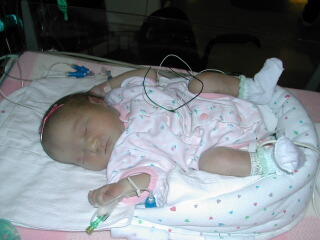
Later in the day the nurse on duty said my daughter's breathing rate was far too rapid. She took her from us and rushed her to the Newborn Intensive Care Unit. I kept up as best I could as they went through the process of admitting her and proceeded to place her in an oxygen rich helmet to ease her breathing stress. Seeing her like that was one of the hardest things I've ever done. There were wires and tubes everywhere. I wasn't allowed to hold my brand new baby. And my wife couldn't even see her since she was bed bound with her C-Section in the maternity ward. My joy and relief had been replaced with fear and concern. One of the nurses watching my daughter told me I looked tired and stressed and that I should go and get some rest. Easier said than done when your wife and only child are both hospitalized. The feeling of helplessness was pretty overwhelming.

My wife recovered from her C-Section in a couple days and was discharged. I was able to wheel her down to the NICU to see our daughter. The doctors had removed her oxygen tank after the first 18 hours. Her breathing distress was caused by a collapsed lung that was in turn caused by the work done at birth to get her breathing. It was good to see her heal so quickly.

It was a week before they would discharge her though. She only weighed five pounds, eleven ounces at birth and lost weight while in the NICU. Her strength was poor and she just wasn't thriving. They had to insert a feeding tube to get her gaining weight. She failed her newborn hearing tests as well and I was faced with the possibility of having a daughter with hearing impairment. This was the first inkling of the challenges ahead for my little daughter and I was really unsure what to think. It certainly wasn't easy to cope with. What would it be like raising a child with a disability?

Finally my little one could keep her blood oxygen levels up by herself, had gained a few ounces, and things were looking up. The doctors removed the food tube. And my wife and I took her home. We were grateful for the fact that she was alive even though she'd had a rocky start. It was good to finally have all of my little family under our own little roof.

I also remember having a pretty negative opinion of medical professionals earlier in my life. I felt like most that I'd come in contact were "in it for the money". After owing the life of my little one and my wife to them, I changed my tune.

Introduction

Over the last 18 months my life has changed beyond what I could have imagined possible. My wife and I welcomed our first child into the world in January, 2004. My daughter's arrival was a very trying time. After some months of tests and other doctor visits she was diagnosed with a rare genetic disorder known as 1P36 Deletion syndrome.

In the coming posts I'll elaborate on some experiences that hopefully will be helpful to parents who have been through or are currently going through some similar things. At the very least it will be therapeutic for me to express them regardless of who's out there reading.